Girls Stature-for-Age Growth Curves
Visual percentile curves showing 3rd, 10th, 25th, 50th, 75th, 90th, and 97th percentiles derived from CDC 2000 female growth standards (ages 2 to 20 years).
Girls Height Reference Table (cm & ft/in)
| Age | 3rd % | 25th % | 50th % Median | 75th % | 97th % |
|---|---|---|---|---|---|
| 2 Years | 80.8 cm | 84.4 cm | 86.4 cm (2' 10.0") | 88.4 cm | 92.0 cm |
| 4 Years | 96.7 cm | 101.8 cm | 104.6 cm (3' 5.2") | 107.4 cm | 112.4 cm |
| 6 Years | 108.5 cm | 114.7 cm | 118.2 cm (3' 10.5") | 121.7 cm | 127.8 cm |
| 8 Years | 118.8 cm | 126.3 cm | 130.4 cm (4' 3.3") | 134.5 cm | 141.8 cm |
| 10 Years | 129.4 cm | 138.2 cm | 143.1 cm (4' 8.3") | 148.0 cm | 156.7 cm |
| 12 Years | 140.2 cm | 149.8 cm | 155.2 cm (5' 1.1") | 160.7 cm | 170.7 cm |
| 14 Years | 147.4 cm | 156.2 cm | 161.3 cm (5' 3.5") | 166.5 cm | 176.1 cm |
| 16 Years | 150.5 cm | 158.3 cm | 162.9 cm (5' 4.1") | 167.6 cm | 176.4 cm |
| 18 Years | 151.3 cm | 158.8 cm | 163.2 cm (5' 4.3") | 167.7 cm | 176.2 cm |
Average Height for Girls by Age
Parents frequently inquire about the average height for girls at different stages of childhood and adolescence. In clinical growth standards published by the CDC National Center for Health Statistics (NCHS) and the World Health Organization (WHO), "average" height is defined as the 50th percentile (median) value.
At the 50th percentile, exactly half of the healthy population of girls of the same chronological age are taller and half are shorter. The reference table below details median heights for girls from age 2 through 18 in centimeters as well as feet and inches:
| Age | Median Height (cm) | Median Height (ft & in) | Typical Height Span (25th - 75th %) |
|---|---|---|---|
| 2 Years | 86.4 cm | 2' 10.0" | 84.4 cm – 88.4 cm (2' 9.2" – 2' 10.8") |
| 3 Years | 96.8 cm | 3' 2.1" | 94.3 cm – 99.2 cm (3' 1.1" – 3' 3.1") |
| 4 Years | 104.6 cm | 3' 5.2" | 101.8 cm – 107.4 cm (3' 4.1" – 3' 6.3") |
| 5 Years | 111.7 cm | 3' 8.0" | 108.5 cm – 114.8 cm (3' 6.7" – 3' 9.2") |
| 6 Years | 118.2 cm | 3' 10.5" | 114.7 cm – 121.7 cm (3' 9.2" – 3' 11.9") |
| 7 Years | 124.4 cm | 4' 1.0" | 120.6 cm – 128.2 cm (3' 11.5" – 4' 2.5") |
| 8 Years | 130.4 cm | 4' 3.3" | 126.3 cm – 134.5 cm (4' 1.7" – 4' 5.0") |
| 9 Years | 136.6 cm | 4' 5.8" | 132.1 cm – 141.1 cm (4' 4.0" – 4' 7.5") |
| 10 Years | 143.1 cm | 4' 8.3" | 138.2 cm – 148.0 cm (4' 6.4" – 4' 10.3") |
| 11 Years | 149.6 cm | 4' 10.9" | 144.3 cm – 154.9 cm (4' 8.8" – 5' 1.0") |
| 12 Years | 155.2 cm | 5' 1.1" | 149.8 cm – 160.7 cm (4' 11.0" – 5' 3.3") |
| 13 Years | 159.1 cm | 5' 2.6" | 153.7 cm – 164.6 cm (5' 0.5" – 5' 4.8") |
| 14 Years | 161.3 cm | 5' 3.5" | 156.2 cm – 166.5 cm (5' 1.5" – 5' 5.6") |
| 15 Years | 162.4 cm | 5' 3.9" | 157.6 cm – 167.3 cm (5' 2.1" – 5' 5.9") |
| 16 Years | 162.9 cm | 5' 4.1" | 158.3 cm – 167.6 cm (5' 2.3" – 5' 6.0") |
| 17 Years | 163.1 cm | 5' 4.2" | 158.6 cm – 167.7 cm (5' 2.5" – 5' 6.0") |
| 18 Years | 163.2 cm | 5' 4.3" | 158.8 cm – 167.7 cm (5' 2.5" – 5' 6.0") |
Individual girls naturally vary around these median values. A girl who is taller or shorter than the 50th percentile is simply expressing normal physiological diversity. Compare female growth patterns with male benchmarks on our Boys Height Chart or review broader population summaries on Average Height by Age.
Girls Height Percentile Chart Explained
A girls height percentile measures where an individual girl stands relative to a standardized reference population of 100 healthy girls of the exact same age. Percentile curves do not represent scores to achieve, but rather distribution bands across a population.
Standard clinical growth charts delineate Nine major percentile channels:
- 3rd Percentile: Approximately 3% of healthy girls are shorter; 97% are taller. This marks the lower standard clinical threshold.
- 5th Percentile: 5% of girls are shorter; 95% are taller.
- 10th Percentile: 10% of girls are shorter; 90% are taller.
- 25th Percentile: 25% of girls are shorter; 75% are taller. Represents a lower-average stature.
- 50th Percentile (Median): Exactly 50% of girls are shorter and 50% are taller.
- 75th Percentile: 75% of girls are shorter; 25% are taller. Represents an upper-average stature.
- 90th Percentile: 90% of girls are shorter; 10% are taller.
- 95th Percentile: 95% of girls are shorter; 5% are taller.
- 97th Percentile: 97% of girls are shorter; 3% are taller. Marks the upper standard clinical threshold.
Being in any percentile channel between the 3rd and 97th percentiles is medically recognized as normal, provided the girl tracks consistently along her established curve over time.

How to Read a Girls Height Chart
Reading a female growth chart accurately involves five simple steps:
- Find the Girl's Age: Determine her exact age in completed years and months. Locate age along the horizontal axis of visual charts.
- Find Her Measured Height: Record her standing stature accurately in centimeters or inches along the vertical axis.
- Compare Measurement with the Chart: Follow the vertical age line up and the horizontal height line across until they intersect.
- Identify the Percentile Channel: Note which curved percentile line lies nearest to the intersection point. If it falls between two lines (e.g., between the 25th and 50th), her percentile lies within that interval.
- Contextualize Over Time: Compare current placement with previous measurements to evaluate overall growth trajectory.

For instant calculation without reading visual axes manually, use our dedicated Child Height Percentile Calculator or primary Height Percentile Calculator.
What Does the 50th Percentile Mean for Girls?
The 50th percentile serves as the mathematical midpoint (median) of the reference dataset. It means that out of 100 healthy girls of the exact same age:
- 50 girls are shorter than the 50th percentile mark.
- 50 girls are taller than the 50th percentile mark.
The 50th percentile is a clinical reference mark, not an optimal target height. A girl at the 15th percentile or the 85th percentile is typically just as healthy as a girl at the 50th percentile. Height percentiles reflect natural genetic and developmental diversity across the population.
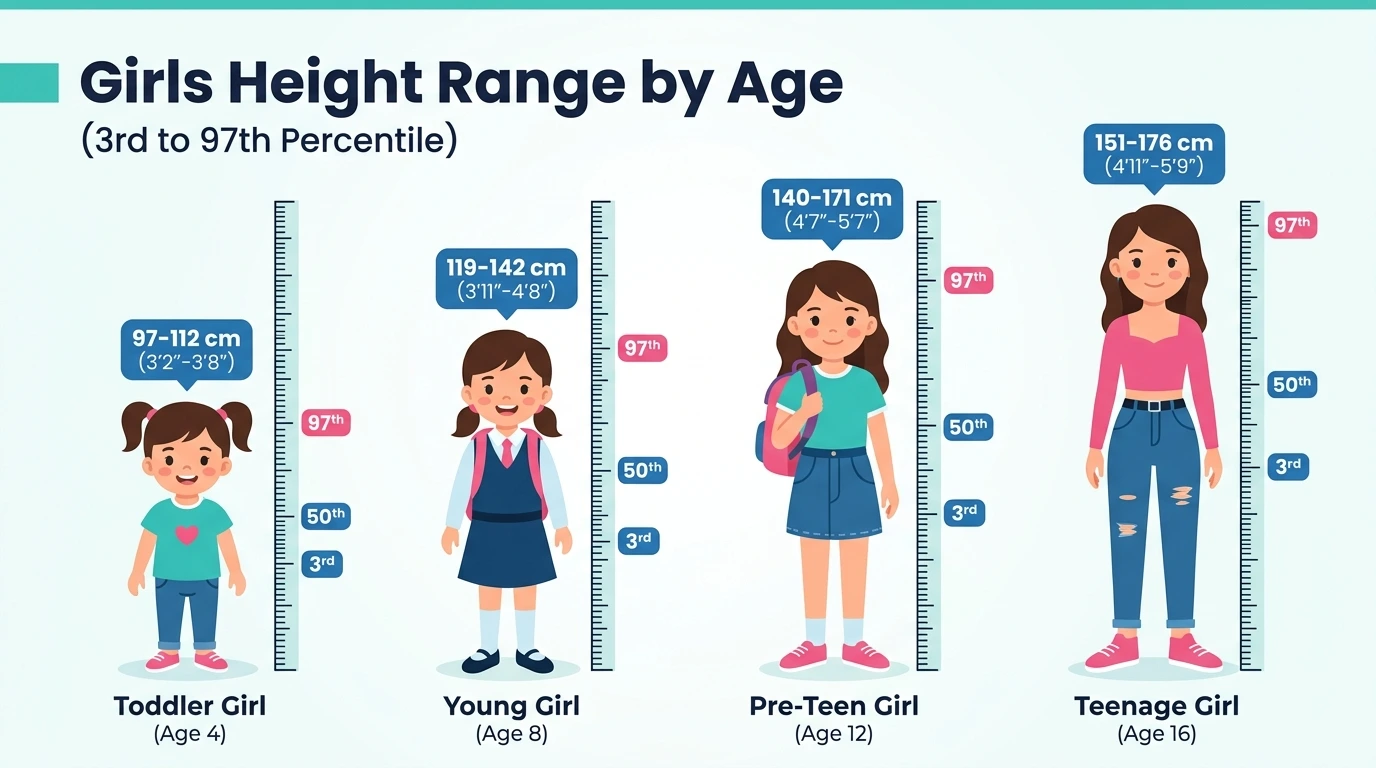
Girls Height Range by Age
Girls of identical chronological age often display noticeable differences in stature. Standard growth benchmarks define a physiological height range spanning from the 3rd percentile to the 97th percentile.
For example, at age 10:
- A girl at the 3rd percentile measures 129.4 cm (4' 3.0").
- A girl at the 50th percentile measures 143.1 cm (4' 8.3").
- A girl at the 97th percentile measures 156.7 cm (5' 1.7").
All three measurements fall within expected healthy population parameters. Differences in familial genetics, skeletal maturation rate, and the timing of pubertal onset account for these natural variations.
Girls Height by Age in cm
Centimeters (cm) are the standard unit of measurement used in medical research, clinical pediatric evaluations, and WHO growth tracking. Metric measurements provide precise monitoring of annual growth velocity.
| Age | 3rd % (cm) | 25th % (cm) | 50th % Median (cm) | 75th % (cm) | 97th % (cm) |
|---|---|---|---|---|---|
| 2 Years | 80.8 cm | 84.4 cm | 86.4 cm | 88.4 cm | 92.0 cm |
| 3 Years | 89.9 cm | 94.3 cm | 96.8 cm | 99.2 cm | 103.6 cm |
| 4 Years | 96.7 cm | 101.8 cm | 104.6 cm | 107.4 cm | 112.4 cm |
| 5 Years | 102.9 cm | 108.5 cm | 111.7 cm | 114.8 cm | 120.4 cm |
| 6 Years | 108.5 cm | 114.7 cm | 118.2 cm | 121.7 cm | 127.8 cm |
| 7 Years | 113.7 cm | 120.6 cm | 124.4 cm | 128.2 cm | 134.9 cm |
| 8 Years | 118.8 cm | 126.3 cm | 130.4 cm | 134.5 cm | 141.8 cm |
| 9 Years | 124.0 cm | 132.1 cm | 136.6 cm | 141.1 cm | 149.1 cm |
| 10 Years | 129.4 cm | 138.2 cm | 143.1 cm | 148.0 cm | 156.7 cm |
| 11 Years | 135.0 cm | 144.3 cm | 149.6 cm | 154.9 cm | 164.4 cm |
| 12 Years | 140.2 cm | 149.8 cm | 155.2 cm | 160.7 cm | 170.7 cm |
| 13 Years | 144.4 cm | 153.7 cm | 159.1 cm | 164.6 cm | 174.5 cm |
| 14 Years | 147.4 cm | 156.2 cm | 161.3 cm | 166.5 cm | 176.1 cm |
| 15 Years | 149.4 cm | 157.6 cm | 162.4 cm | 167.3 cm | 176.4 cm |
| 16 Years | 150.5 cm | 158.3 cm | 162.9 cm | 167.6 cm | 176.4 cm |
| 17 Years | 151.0 cm | 158.6 cm | 163.1 cm | 167.7 cm | 176.3 cm |
| 18 Years | 151.3 cm | 158.8 cm | 163.2 cm | 167.7 cm | 176.2 cm |
To convert metric height figures into feet and fractional inches, try our interactive Height Converter.
Girls Height by Age in Feet and Inches
For parents in the United States and regions using imperial measurements, height is routinely reported in feet and inches. Below are the corresponding reference figures for girls, mathematically converted from official WHO and CDC datasets (1 inch = 2.54 cm):
| Age | 3rd % (ft/in) | 25th % (ft/in) | 50th % Median (ft/in) | 75th % (ft/in) | 97th % (ft/in) |
|---|---|---|---|---|---|
| 2 Years | 2' 7.8" | 2' 9.2" | 2' 10.0" | 2' 10.8" | 3' 0.2" |
| 3 Years | 2' 11.4" | 3' 1.1" | 3' 2.1" | 3' 3.1" | 3' 4.8" |
| 4 Years | 3' 2.1" | 3' 4.1" | 3' 5.2" | 3' 6.3" | 3' 8.3" |
| 5 Years | 3' 4.5" | 3' 6.7" | 3' 8.0" | 3' 9.2" | 3' 11.4" |
| 6 Years | 3' 6.7" | 3' 9.2" | 3' 10.5" | 3' 11.9" | 4' 2.3" |
| 7 Years | 3' 8.8" | 3' 11.5" | 4' 1.0" | 4' 2.5" | 4' 5.1" |
| 8 Years | 3' 10.8" | 4' 1.7" | 4' 3.3" | 4' 5.0" | 4' 7.8" |
| 9 Years | 4' 0.8" | 4' 4.0" | 4' 5.8" | 4' 7.5" | 4' 10.7" |
| 10 Years | 4' 3.0" | 4' 6.4" | 4' 8.3" | 4' 10.3" | 5' 1.7" |
| 11 Years | 4' 5.2" | 4' 8.8" | 4' 10.9" | 5' 1.0" | 5' 4.7" |
| 12 Years | 4' 7.2" | 4' 11.0" | 5' 1.1" | 5' 3.3" | 5' 7.2" |
| 13 Years | 4' 8.8" | 5' 0.5" | 5' 2.6" | 5' 4.8" | 5' 8.7" |
| 14 Years | 4' 10.0" | 5' 1.5" | 5' 3.5" | 5' 5.6" | 5' 9.3" |
| 15 Years | 4' 10.8" | 5' 2.1" | 5' 3.9" | 5' 5.9" | 5' 9.5" |
| 16 Years | 4' 11.2" | 5' 2.3" | 5' 4.1" | 5' 6.0" | 5' 9.4" |
| 17 Years | 4' 11.5" | 5' 2.5" | 5' 4.2" | 5' 6.0" | 5' 9.4" |
| 18 Years | 4' 11.6" | 5' 2.5" | 5' 4.3" | 5' 6.0" | 5' 9.4" |
Girls Height Growth From Birth to 18 Years
Female height growth is dynamic and non-linear. Stature progression changes rate across five key physiological developmental periods:
- Infancy (Birth to 12 Months): The fastest period of post-natal growth. A female infant typically gains roughly 24 to 25 cm (9.5 to 10 inches) during her first year.
- Toddler Years (1 to 3 Years): Growth remains rapid but begins to slow, averaging about 10 to 12 cm in year two and 8 to 9 cm in year three.
- Early Childhood (4 to 6 Years): Linear growth transitions into a steady pace of approximately 6 to 7 cm (2.4 to 2.8 inches) per year.
- School-Age Years (7 to 10 Years): Growth remains steady at roughly 5 to 6 cm per year until the onset of prepubertal changes.
- Adolescence (11 to 18 Years): Marked by the pubertal growth spurt, followed by deceleration and final growth plate fusion between ages 14 and 16.

How Much Do Girls Grow Each Year?
Annual growth velocity measures linear height gain in centimeters or inches per year. Average annual height gains for girls across development include:
- Age 1 to 2 years: ~11 to 12 cm (4.3 to 4.7 inches) per year
- Age 2 to 4 years: ~8 to 9 cm (3.1 to 3.5 inches) per year
- Age 4 to 9 years: ~5 to 6.5 cm (2.0 to 2.6 inches) per year
- Pubertal Peak (Age 10 to 12 years): ~7 to 10 cm (2.8 to 4.0 inches) per year

Growth velocity is not uniform across all months of the year; brief periods of rapid growth often alternate with quieter growth phases.
Girls' Height Growth During Puberty
Puberty introduces a major acceleration in female height trajectory. Key features of the female pubertal growth spurt include:
- Earlier Timing Than Boys: Girls typically start their pubertal growth spurt approximately 1.5 to 2 years earlier than boys, usually between ages 9 and 12.
- Peak Height Velocity (PHV): During peak pubertal growth (often around Tanner stage 3), girls can gain 7 to 10 cm (3 to 4 inches) in a single 12-month period.
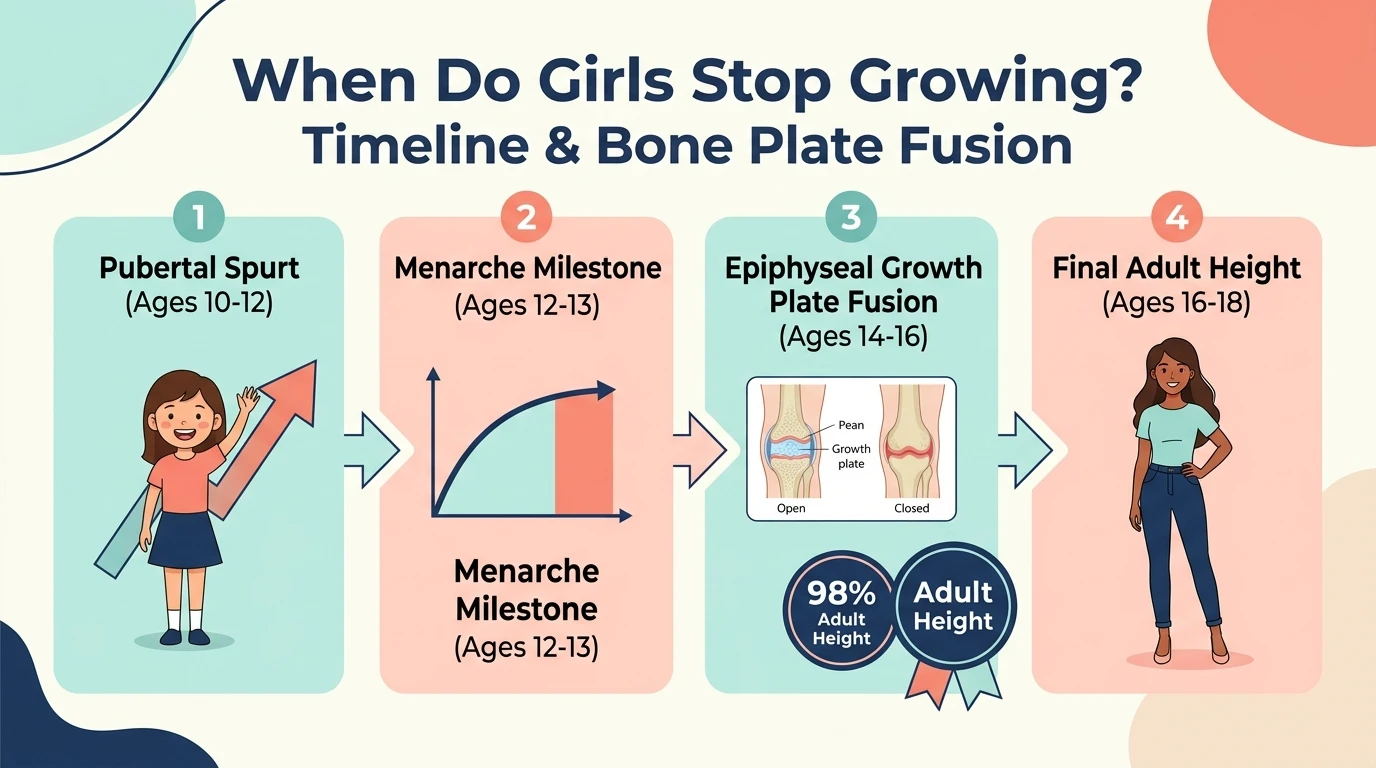
- Menarche and Growth Deceleration: The pubertal peak generally occurs before menarche (first menstrual period). After menarche, growth velocity slows significantly, with most girls gaining an additional 5 to 7.5 cm (2 to 3 inches) before final height is reached.
- Timing Differences: Early pubertal onset ("early bloomers") leads to an early growth spurt, while late onset ("late bloomers") results in a later spurt.

When Do Girls Stop Growing?
Linear stature growth stops when the epiphyseal growth plates located near the ends of long bones undergo complete ossification (fusion). In girls:
- Estrogen plays a key role in promoting both pubertal bone growth and eventual growth plate closure.
- Most girls achieve 98% or more of their final adult height by age 14 to 16.
- Complete growth plate fusion usually occurs approximately 2 to 2.5 years after menarche.
- Minor residual spinal growth may continue in some individuals until age 17 or 18.
Factors That Affect Girls' Height
A girl's overall height development is governed by a combination of biological and environmental influences:
- Genetics (Parental Stature): Inherited genetic factors account for approximately 80% of total height variation in healthy populations, as shown in studies indexed by the National Institutes of Health (NIH).
- Nutritional Intake: Sufficient macronutrients, essential amino acids, calcium, zinc, and Vitamin D support bone elongation.
- Sleep Quality: Deep Stage 3 NREM sleep triggers pulsatile Growth Hormone (GH) secretion from the pituitary gland.
- General Health: Chronic childhood illnesses or endocrine disorders can influence growth velocity.
- Pubertal Maturation Rate: The age at which pubertal hormone levels rise directly shapes the duration of active bone growth.

Genetics and Girls' Height
Genetics is the single strongest determinant of a girl's adult height. Parents often share familial patterns of stature, with daughters tending to reflect mid-parental genetic potential.
Pediatricians evaluate genetic potential using the Female Mid-Parental Height Method:
Target Adult Height for Girls (cm) = [ (Father's Height cm - 13 cm) + Mother's Height cm ] ÷ 2
In imperial units: [ (Father's Height in - 5 in) + Mother's Height in ] ÷ 2. Mid-parental calculations yield a statistical target range (±5 cm or ±2 inches), rather than a guaranteed outcome.
To estimate your daughter's projected adult stature based on parental heights and current percentile trajectory, try our specialized Child Height Prediction Calculator.
How to Measure a Girl's Height Correctly
Accurate height measurement is crucial for reliable percentile interpretation. Following standardized protocols adapted from CDC Anthropometric Guidelines, follow these steps:
- Remove Shoes & Hair Accessories: Take off shoes, socks, hats, and bulky hair ties or ponytails.
- Select a Flat Surface: Stand the child on an uncarpeted, level floor against a flat, vertical wall.
- Position Body (4-Point Contact): Ensure the back of the head, shoulder blades, buttocks, and heels touch the wall.
- Align Heels & Feet: Keep feet flat with heels together and toes pointing slightly outward.
- Head Alignment (Frankfort Horizontal Plane): Position her head so the line of sight is horizontal and parallel to the floor.
- Use a Rigid Headboard: Lower a flat, right-angled block or firm headboard down until it compresses hair flat against the crown.
- Mark & Record: Mark the wall at the headboard base and measure to the nearest 0.1 cm or 1/8 inch.
- Confirm Consistency: Repeat the measurement to verify precision before plotting on growth charts.

Why One Height Measurement Is Not Enough
A single height reading provides only a point-in-time snapshot. A girl measuring at the 25th percentile at age 7 is growing normally if she has steadily tracked the 25th percentile curve since infancy.
Evaluating serial measurements over time allows pediatricians to calculate growth velocity and detect true upward or downward percentile shifts early.
Tracking a Girl's Height Over Time
Maintaining a simple growth record helps monitor your child's natural trajectory through childhood and adolescence. Recommended tracking fields include:
- Date of measurement
- Exact age in years and completed months
- Measured height (cm or ft/in)
- Calculated percentile channel (using our Height Percentile Calculator)
- Notes on health or pubertal milestones

Average Height vs Height Percentile
It is common to confuse average height with a height percentile:
- Average / Median Height (50th Percentile): The central midpoint of the population dataset. Exactly half of healthy girls measure above this height and half measure below it.
- Height Percentile: A relative ranking showing what percentage of age-matched female peers your child exceeds in height.
- Individual Height Measurement: The raw stature value recorded in centimeters or feet and inches.
Example: An 11-year-old girl measuring 155 cm is in approximately the 75th percentile. This means she is taller than 75% of 11-year-old girls and shorter than 25%. Her stature is above average, but completely normal and healthy.
Can a Girl's Height Percentile Change?
Yes, a girl's height percentile can shift across childhood and adolescence. Percentile channel shifts are especially common during pubertal growth phases (ages 9 to 14):
- Early Pubertal Onset ("Early Bloomers"): Girls who enter puberty earlier than average may temporarily jump to a higher percentile channel (e.g., moving from the 50th to the 75th percentile at age 10).
- Later Pubertal Onset ("Late Bloomers"): Girls who mature later may experience a temporary dip in relative percentile ranking while peers spurt, before catching up during their own later spurt.
Minor shifts between adjacent percentile lines are normal. If a child crosses two or more major percentile curves downward, consult a qualified healthcare provider for clinical evaluation.
Girls Height by Specific Age (2 to 18 Years)
Below is a age-by-age reference breakdown of median (50th percentile) heights and standard 3rd–97th percentile ranges for girls:
2-Year-Old Girl Height
Median height: 86.4 cm (2' 10.0"). Healthy reference range (3rd to 97th percentile): 80.8 cm to 92.0 cm (2' 7.8" to 3' 0.2").
3-Year-Old Girl Height
Median height: 96.8 cm (3' 2.1"). Healthy reference range: 89.9 cm to 103.6 cm (2' 11.4" to 3' 4.8").
4-Year-Old Girl Height
Median height: 104.6 cm (3' 5.2"). Healthy reference range: 96.7 cm to 112.4 cm (3' 2.1" to 3' 8.3").
5-Year-Old Girl Height
Median height: 111.7 cm (3' 8.0"). Healthy reference range: 102.9 cm to 120.4 cm (3' 4.5" to 3' 11.4").
6-Year-Old Girl Height
Median height: 118.2 cm (3' 10.5"). Healthy reference range: 108.5 cm to 127.8 cm (3' 6.7" to 4' 2.3").
7-Year-Old Girl Height
Median height: 124.4 cm (4' 1.0"). Healthy reference range: 113.7 cm to 134.9 cm (3' 8.8" to 4' 5.1").
8-Year-Old Girl Height
Median height: 130.4 cm (4' 3.3"). Healthy reference range: 118.8 cm to 141.8 cm (3' 10.8" to 4' 7.8").
9-Year-Old Girl Height
Median height: 136.6 cm (4' 5.8"). Healthy reference range: 124.0 cm to 149.1 cm (4' 0.8" to 4' 10.7").
10-Year-Old Girl Height
Median height: 143.1 cm (4' 8.3"). Healthy reference range: 129.4 cm to 156.7 cm (4' 3.0" to 5' 1.7").
11-Year-Old Girl Height
Median height: 149.6 cm (4' 10.9"). Healthy reference range: 135.0 cm to 164.4 cm (4' 5.2" to 5' 4.7").
12-Year-Old Girl Height
Median height: 155.2 cm (5' 1.1"). Healthy reference range: 140.2 cm to 170.7 cm (4' 7.2" to 5' 7.2").
13-Year-Old Girl Height
Median height: 159.1 cm (5' 2.6"). Healthy reference range: 144.4 cm to 174.5 cm (4' 8.8" to 5' 8.7").
14-Year-Old Girl Height
Median height: 161.3 cm (5' 3.5"). Healthy reference range: 147.4 cm to 176.1 cm (4' 10.0" to 5' 9.3").
15-Year-Old Girl Height
Median height: 162.4 cm (5' 3.9"). Healthy reference range: 149.4 cm to 176.4 cm (4' 10.8" to 5' 9.5").
16-Year-Old Girl Height
Median height: 162.9 cm (5' 4.1"). Healthy reference range: 150.5 cm to 176.4 cm (4' 11.2" to 5' 9.4").
17-Year-Old Girl Height
Median height: 163.1 cm (5' 4.2"). Healthy reference range: 151.0 cm to 176.3 cm (4' 11.5" to 5' 9.4").
18-Year-Old Girl Height
Median height: 163.2 cm (5' 4.3"). Healthy reference range: 151.3 cm to 176.2 cm (4' 11.6" to 5' 9.4").
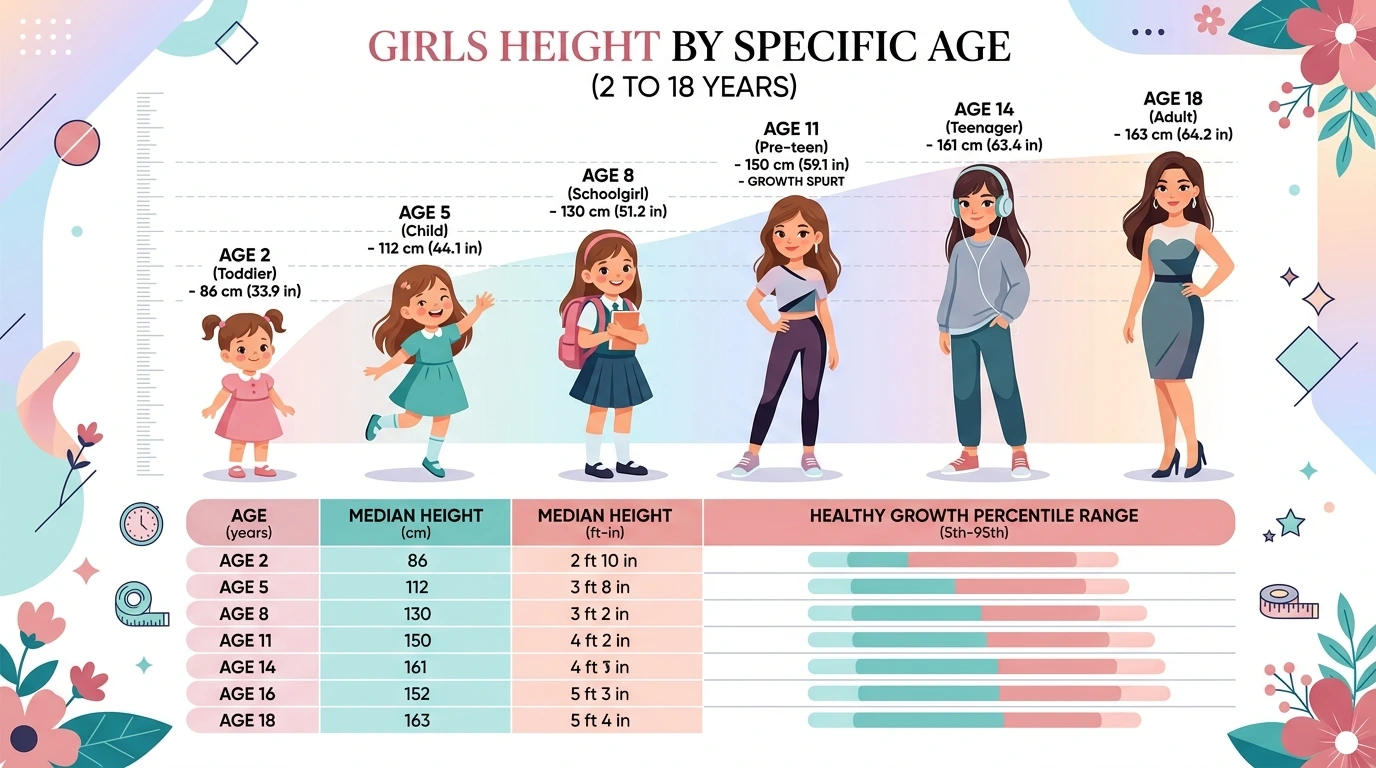
Girls Height Growth Patterns by Age Group
Female height development progresses through distinct physiological growth stages:
- Infancy (0 to 12 Months): Rapid length gain averaging 24–25 cm per year, driven by infant nutrition and metabolic factors.
- Toddlerhood (1 to 3 Years): Steady velocity deceleration from ~11 cm/year down to ~8 cm/year as growth curves settle into genetic trajectory channels.
- Early Childhood (4 to 6 Years): Stable linear growth rate of ~6 to 7 cm/year.
- Middle Childhood (7 to 9 Years): Quiescent prepubertal growth period averaging ~5 to 6 cm/year.
- Adolescence (10 to 18 Years): Pubertal growth acceleration (peak velocity ~7 to 10 cm/year), followed by post-menarche deceleration and growth plate fusion.

Girls Height Chart vs Growth Chart
While often used interchangeably, there is a clear distinction between a height chart and a full growth chart:
- Girls Height Chart: Focuses specifically on stature-for-age metrics, tracking linear height progression and percentile channels from birth through 20 years.
- Pediatric Growth Chart: A broader multi-metric clinical tool used by pediatricians that tracks stature, body weight, weight-for-stature, body mass index (BMI), and head circumference (in infants).
This page provides dedicated stature-for-age reference standards specifically optimized for girls' height analysis.
Expected Adult Height for Girls
Estimating a girl's expected adult height relies primarily on parental stature and her individual growth trajectory. Pediatricians commonly use the Mid-Parental Target Height calculation:
Target Adult Height for Girls = [ (Father's Height - 13 cm) + Mother's Height ] ÷ 2
Target height estimates provide a statistical center point. Most healthy girls reach a final adult stature within ±5 cm (±2 inches) of this target. For an instant calculation tailored to your daughter's growth parameters, use our Child Height Prediction Calculator.
Girls Height Chart Data Source and Methodology
The reference standards and percentile curves on this page are derived directly from official pediatric growth datasets:
- WHO Child Growth Standards (0 to 24 Months): Based on data from the World Health Organization Multicentre Growth Reference Study, establishing physiological growth standards for infants.
- CDC 2000 Growth Charts (2 to 20 Years): Based on clinical stature-for-age datasets published by the CDC National Center for Health Statistics (NCHS).
-
Cole's LMS Percentile Calculation Method: Percentiles are calculated using Cole's LMS method, published in the European Journal of Clinical Nutrition:
Z = [ (X / M)^L - 1 ] / (L * S) - Unit Conversion Standard: Imperial measurements (feet and inches) use exact conversions maintained by the National Institute of Standards and Technology (NIST) (1 inch = 2.54 cm).
Important Notes About Girls Height Charts
Growth charts are clinical population reference tools designed to monitor broad growth trends. Please keep the following clinical principles in mind:
- Population Tool: A growth chart describes statistical distributions across a population; it is not an individual medical diagnosis.
- Percentile Shifts Can Occur: Shifts across percentile channels occur naturally during pubertal timing variations ("early" or "late" bloomers).
- Medical Consultation: If a girl experiences a persistent downward trajectory crossing two or more major percentile lines, consult a pediatrician certified by the American Academy of Pediatrics (AAP) for professional evaluation.
Frequently Asked Questions About Girls Height
Average height varies across developmental stages. At age 2, the median girl is 86.4 cm (2' 10.0"). By age 6, median height is 118.2 cm (3' 10.5"). At age 10, it is 143.1 cm (4' 8.3"). At age 14, median height reaches 161.3 cm (5' 3.5"), and by age 18, final median adult height is approximately 163.2 cm (5' 4.3").
The median (50th percentile) height of a 10-year-old girl is approximately 143.1 cm (4 feet 8.3 inches). Healthy 10-year-old girls typically range between 129.4 cm (3rd percentile) and 156.7 cm (97th percentile).
There is no single required height for a 12-year-old girl. The median height is 155.2 cm (5 feet 1.1 inches), but healthy 12-year-olds span from 140.2 cm to 170.7 cm depending on whether their pubertal growth spurt has begun.
The 50th percentile is the central median midpoint where 50% of healthy girls in reference datasets are taller and 50% are shorter. It serves as a benchmark line, not a required minimum target.
Being in the 90th percentile means a girl is taller than 90% of girls her exact chronological age, while only 10% are taller.
Yes. Percentile shifts are especially common during pubertal growth spurts between ages 9 and 14 as girls mature at different rates.
In toddlerhood, girls grow ~8–9 cm/year. During middle childhood, growth averages ~5–6.5 cm/year. During the pubertal peak, growth velocity accelerates to ~7–10 cm/year.
Most girls complete the majority of their height growth by age 14 to 16, typically within 2 to 2.5 years after menarche (first period).
Differences in parental genetics, bone maturation rates, timing of pubertal growth spurts, nutrition, and general health account for natural height variations.
Remove shoes and hair accessories, stand flat against a wall with heels, buttocks, shoulders, and head touching, align eyes parallel to the floor, and lower a right-angled headboard flat to the crown of the head.
Average height is the single median midpoint value. A height percentile is a rank from 1 to 99 showing what percentage of peers an individual girl exceeds in stature.
Plot your child's height against her exact age to identify her current percentile channel, and track multiple measurements over time to monitor her growth trajectory.