Average Height Table for Children & Teens (Ages 1 - 18)
The reference table below displays the 50th percentile (median) height for boys and girls from age 1 to 18 years, based on authoritative standards from the World Health Organization (WHO Child Growth Standards for birth to 2 years) and the Centers for Disease Control and Prevention (CDC Growth Charts for ages 2 to 20).
Age
Average Boy Height (cm)
Average Boy Height (ft/in)
Average Girl Height (cm)
Average Girl Height (ft/in)
1 Year
76.5 cm
2' 6.1"
74.0 cm
2' 5.1"
2 Years
88.8 cm
2' 11.0"
86.4 cm
2' 10.0"
3 Years
97.9 cm
3' 2.5"
96.8 cm
3' 2.1"
4 Years
105.7 cm
3' 5.6"
104.6 cm
3' 5.2"
5 Years
112.7 cm
3' 8.4"
111.7 cm
3' 8.0"
6 Years
119.2 cm
3' 11.0"
118.2 cm
3' 10.5"
7 Years
125.3 cm
4' 1.3"
124.4 cm
4' 1.0"
8 Years
131.1 cm
4' 3.6"
130.4 cm
4' 3.3"
9 Years
136.7 cm
4' 5.8"
136.6 cm
4' 5.8"
10 Years
142.5 cm
4' 8.1"
143.1 cm
4' 8.3"
11 Years
148.6 cm
4' 10.5"
149.6 cm
4' 10.9"
12 Years
155.3 cm
5' 1.1"
155.2 cm
5' 1.1"
13 Years
162.2 cm
5' 3.9"
159.1 cm
5' 2.6"
14 Years
168.3 cm
5' 6.3"
161.3 cm
5' 3.5"
15 Years
172.8 cm
5' 8.0"
162.4 cm
5' 3.9"
16 Years
175.4 cm
5' 9.1"
162.9 cm
5' 4.1"
17 Years
176.4 cm
5' 9.5"
163.2 cm
5' 4.3"
18 Years
176.7 cm
5' 9.6"
163.3 cm
5' 4.3"
How to read this chart: The median (50th percentile) represents the midpoint where 50% of healthy reference children are taller and 50% are shorter. Individual measurements between the 3rd percentile and 97th percentile are considered healthy population variations.
Average Height for Boys by Age
Boys follow a characteristic growth trajectory marked by rapid early gain, steady childhood progression, and a delayed but intense pubertal growth spurt. During infancy and early childhood, boys are on average slightly taller than girls of the same age.
Between ages 2 and 10, boys gain an average of 5 to 7 cm (2 to 2.8 inches) in height each year. Around age 11 to 13, boys enter puberty, which triggers peak height velocity (PHV). During this peak period, boys typically gain 8 to 10 cm (3.1 to 4 inches) per year before stature levels off near age 18.
Age Range
Boy Growth Stage
Median Height (cm)
Median Height (ft/in)
Birth
Infancy
49.9 cm
1' 7.6"
1 Year
Toddlerhood
76.5 cm
2' 6.1"
3 Years
Preschool
97.9 cm
3' 2.5"
6 Years
Early School Age
119.2 cm
3' 11.0"
10 Years
Pre-Puberty
142.5 cm
4' 8.1"
13 Years
Early Puberty Spurts
162.2 cm
5' 3.9"
16 Years
Mid-Adolescence
175.4 cm
5' 9.1"
18 Years
Mature Stature
176.7 cm
5' 9.6"
To explore full percentile curves, growth charts, and growth velocity metrics for young males, view our complete boys height chart reference guide.
Average Height for Girls by Age
Girls exhibit a unique growth velocity curve that accelerates earlier in biological maturation than boys. While girls start slightly smaller in infancy, they undergo their pubertal growth spurt approximately 1.5 to 2 years earlier than boys.
Around age 9 to 11, many girls begin their pre-pubertal growth acceleration. Between ages 10 and 12, average girl height temporary meets or slightly exceeds average boy height. Peak growth velocity for girls occurs shortly before menarche (first menstrual period), after which linear height growth gradually decelerates and concludes around age 15 to 16.
Age Range
Girl Growth Stage
Median Height (cm)
Median Height (ft/in)
Birth
Infancy
49.1 cm
1' 7.3"
1 Year
Toddlerhood
74.0 cm
2' 5.1"
3 Years
Preschool
96.8 cm
3' 2.1"
6 Years
Early School Age
118.2 cm
3' 10.5"
10 Years
Early Puberty Onset
143.1 cm
4' 8.3"
13 Years
Mid-Puberty Acceleration
159.1 cm
5' 2.6"
16 Years
Late Adolescence
162.9 cm
5' 4.1"
18 Years
Mature Stature
163.3 cm
5' 4.3"
For detailed growth channels, percentile calculations, and milestone guidance tailored for females, explore our dedicated girls height chart page.
Average Height by Age and Gender
Comparing average height across age and gender highlights the sexual dimorphism in human growth trajectories. From birth through age 9, boys maintain a modest height advantage of roughly 1 to 2 cm over girls.
At age 10 to 11, the growth curve experiences a temporary crossover: because girls initiate pubertal maturation earlier, average girl height (143.1 cm at age 10) temporarily surpasses average boy height (142.5 cm at age 10). By age 13 to 14, boys enter their peak growth spurt, surpassing girls and establishing an average adult height differential of approximately 13 cm (5.3 inches).
Age
Boy Median (cm)
Girl Median (cm)
Difference (cm)
Growth Phase Context
Birth
49.9 cm
49.1 cm
+0.8 cm (Boys)
Infant Baseline
2 Years
88.8 cm
86.4 cm
+2.4 cm (Boys)
Toddlerhood
5 Years
112.7 cm
111.7 cm
+1.0 cm (Boys)
Preschool Phase
8 Years
131.1 cm
130.4 cm
+0.7 cm (Boys)
Middle Childhood
10 Years
142.5 cm
143.1 cm
+0.6 cm (Girls)
Girls Pubertal Acceleration
12 Years
155.3 cm
155.2 cm
+0.1 cm (Boys)
Crossover Transition
14 Years
168.3 cm
161.3 cm
+7.0 cm (Boys)
Boys Pubertal Peak
16 Years
175.4 cm
162.9 cm
+12.5 cm (Boys)
Adolescent Maturation
18 Years
176.7 cm
163.3 cm
+13.4 cm (Boys)
Adult Baseline Stature
These median statistics represent reference population benchmarks rather than qualitative standards. Neither taller nor shorter stature indicates superior development; both fall within normal, healthy biological variation.
Average Height by Age in CM
In clinical pediatric medicine and international reference standards (such as the WHO Child Growth Standards), height is recorded strictly in metric centimeters (cm). Centimeter values offer precise tracking of growth velocity without fractional rounding errors.
Age Benchmark
Boys Median Height (cm)
Girls Median Height (cm)
Combined Reference Range (3rd–97th cm)
12 Months
76.5 cm
74.0 cm
68.9 cm – 81.7 cm
24 Months
88.8 cm
86.4 cm
81.0 cm – 94.7 cm
4 Years
105.7 cm
104.6 cm
96.0 cm – 113.8 cm
6 Years
119.2 cm
118.2 cm
108.0 cm – 128.8 cm
8 Years
131.1 cm
130.4 cm
118.5 cm – 142.2 cm
10 Years
142.5 cm
143.1 cm
129.0 cm – 155.5 cm
12 Years
155.3 cm
155.2 cm
139.5 cm – 170.0 cm
14 Years
168.3 cm
161.3 cm
148.0 cm – 181.5 cm
16 Years
175.4 cm
162.9 cm
152.5 cm – 187.0 cm
18 Years
176.7 cm
163.3 cm
153.0 cm – 188.5 cm
To convert any height measurement seamlessly between centimeters, meters, feet, and inches, use our interactive height converter tool.
Average Height by Age in Feet and Inches
For users in the United States and countries utilizing imperial measurements, reference heights are expressed in feet and inches. Every imperial value in our tables is derived directly from exact mathematical conversions ($1 \text{ inch} = 2.54 \text{ cm}$) and rounded consistently to the nearest tenth of an inch.
Age Benchmark
Boys Median (ft/in)
Girls Median (ft/in)
Imperial Conversion Note
1 Year
2' 6.1"
2' 5.1"
76.5 cm / 74.0 cm
2 Years
2' 11.0"
2' 10.0"
88.8 cm / 86.4 cm
4 Years
3' 5.6"
3' 5.2"
105.7 cm / 104.6 cm
6 Years
3' 11.0"
3' 10.5"
119.2 cm / 118.2 cm
8 Years
4' 3.6"
4' 3.3"
131.1 cm / 130.4 cm
10 Years
4' 8.1"
4' 8.3"
142.5 cm / 143.1 cm
12 Years
5' 1.1"
5' 1.1"
155.3 cm / 155.2 cm
14 Years
5' 6.3"
5' 3.5"
168.3 cm / 161.3 cm
16 Years
5' 9.1"
5' 4.1"
175.4 cm / 162.9 cm
18 Years
5' 9.6"
5' 4.3"
176.7 cm / 163.3 cm
When measuring at home, recording fractional inches accurately ensures precise tracking against national CDC benchmarks.
Average Height for Children by Age
Childhood growth represents a continuous, dynamic physiological process divided into distinct developmental phases:
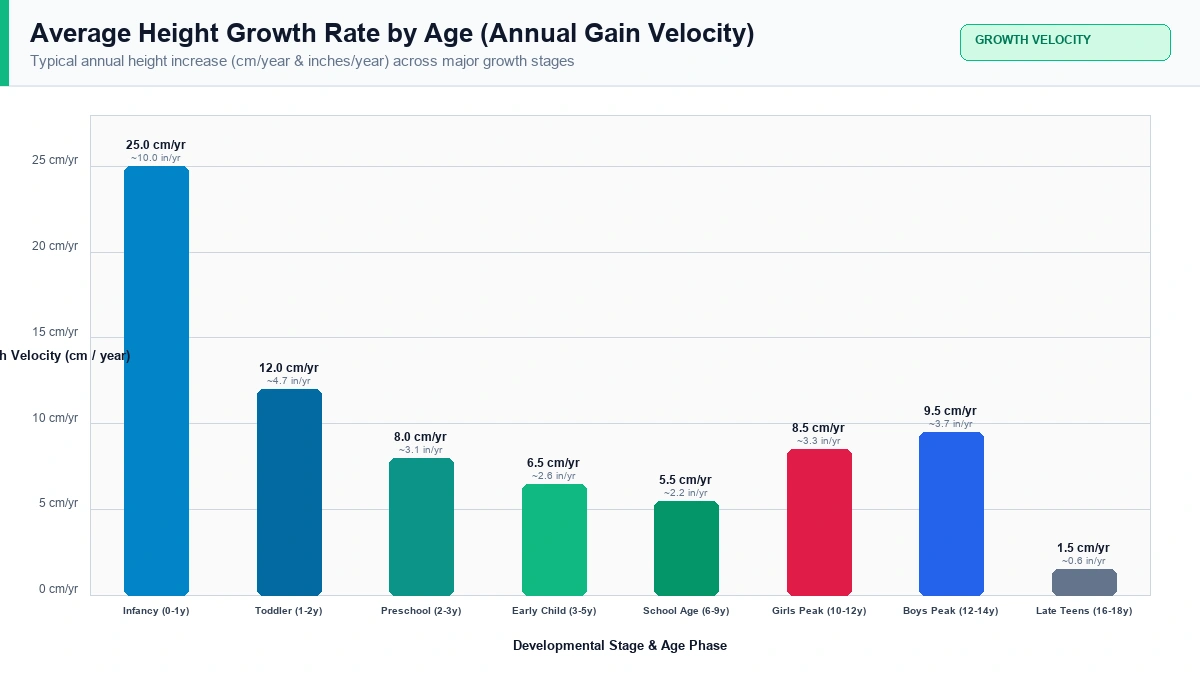
Infancy (Birth to 12 Months): The fastest rate of post-natal growth. Infants increase length by approximately 50% in 12 months, growing about 25 cm (10 inches).
Toddler Years (1 to 3 Years): Growth velocity slows down from the infant peak but remains rapid, averaging 8 to 12 cm per year.
Early Childhood (3 to 5 Years): Preschool years marked by highly predictable linear gains of approximately 6 to 7 cm (2.5 inches) per year.
School-Age Years (6 to 12 Years): A period of steady, constant growth velocity averaging 5 to 6 cm annually prior to pubertal acceleration.
It is completely normal for children of identical chronological age to differ in height due to individual genetic heritage and biological growth rhythms.
Average Height for Children by Age: Developmental milestone guide showing median stature for infancy, toddlerhood, early childhood, and primary school age.
Average Height for Teenagers by Age
Adolescence involves dramatic physical transformation driven by the pubertal growth spurt. Height changes during the teenage years follow distinct stages:
Early Adolescence (Ages 13–14): Girls approach the end of their primary growth acceleration, while boys enter their rapid growth phase, gaining up to 10 cm per year.
Mid-Adolescence (Ages 15–16): Growth velocity decelerates for girls as bone epiphyseal plates begin to close. Boys experience peak linear height extension during these years.
Late Adolescence (Ages 17–18+): Linear height growth reaches completion for most individuals as epiphyseal growth plates fully fuse.
Because pubertal timing varies widely (constitutional early or late bloomers), presenting a single rigid height expectation for every teenager is inaccurate. To evaluate individual pediatric growth curves, try our child height percentile calculator.
Average Height for Teenagers by Age: Character milestone guide showing median stature for teenage boys and girls from age 13 to age 18.
Average Height by Age: Birth to 2 Years
During the first two years of life, growth is measured as recumbent length (lying down flat on a measuring board) rather than standing height. The World Health Organization (WHO) Child Growth Standards provide the global benchmark for infant length.
Age Interval
Boy Length (cm)
Boy Length (ft/in)
Girl Length (cm)
Girl Length (ft/in)
Birth
49.9 cm
1' 7.6"
49.1 cm
1' 7.3"
3 Months
61.4 cm
2' 0.2"
59.8 cm
1' 11.5"
6 Months
67.6 cm
2' 2.6"
65.7 cm
2' 1.9"
9 Months
72.0 cm
2' 4.3"
70.1 cm
2' 3.6"
12 Months (1 Year)
75.7 cm
2' 5.8"
74.0 cm
2' 5.1"
18 Months (1.5 Years)
82.3 cm
2' 8.4"
80.7 cm
2' 7.8"
24 Months (2 Years)
87.8 cm
2' 10.6"
86.4 cm
2' 10.0"
Because infants grow so rapidly, tracking monthly or quarterly intervals provides a far clearer picture than annual snapshots alone.
Average Height by Age: 2 to 5 Years
Between ages 2 and 5 (the preschool years), children transition from recumbent length measurement to standing height (stature). During this phase, toddlers lose infant fat, posture uprights, and grow at a steady rate of approximately 6 to 8 cm (2.5 to 3 inches) per year.
Age 2: Boys 88.8 cm (2' 11.0") | Girls 86.4 cm (2' 10.0")
Age 3: Boys 97.9 cm (3' 2.5") | Girls 96.8 cm (3' 2.1")
Age 4: Boys 105.7 cm (3' 5.6") | Girls 104.6 cm (3' 5.2")
Age 5: Boys 112.7 cm (3' 8.4") | Girls 111.7 cm (3' 8.0")
Average Height by Age: 6 to 12 Years
The primary school years represent a period of consistent linear growth velocity. Children typically gain 5 to 6 cm per year during early primary school. Toward the end of this range (ages 9–12), individual differences widen dramatically due to varying onset times of pre-pubertal maturation.
Age 6: Boys 119.2 cm (3' 11.0") | Girls 118.2 cm (3' 10.5")
Age 8: Boys 131.1 cm (4' 3.6") | Girls 130.4 cm (4' 3.3")
Age 10: Boys 142.5 cm (4' 8.1") | Girls 143.1 cm (4' 8.3")
Age 12: Boys 155.3 cm (5' 1.1") | Girls 155.2 cm (5' 1.1")
Average Height by Age: 13 to 18 Years
Adolescence encompasses major pubertal height acceleration followed by deceleration as final adult height is established.
Age 13: Boys 162.2 cm (5' 3.9") | Girls 159.1 cm (5' 2.6")
Age 14: Boys 168.3 cm (5' 6.3") | Girls 161.3 cm (5' 3.5")
Age 16: Boys 175.4 cm (5' 9.1") | Girls 162.9 cm (5' 4.1")
Age 18: Boys 176.7 cm (5' 9.6") | Girls 163.3 cm (5' 4.3")
How Average Height Changes With Age
Human height growth is non-linear. Rather than increasing at a constant flat rate, human height follows a characteristic curved trajectory consisting of four distinct physiological phases:
Infant Acceleration Phase: Rapid initial post-natal expansion during the first 12–18 months.
Childhood Steady Phase: Slower, highly stable linear velocity during middle childhood.
Adolescent Pubertal Peak: Sharp acceleration in growth velocity triggered by sex steroid release.
Adolescent Deceleration & Plateau Phase: Gradual slowing as epiphyseal growth plates fuse, concluding in final adult stature.
How Much Height Do Children Gain Each Year?
Growth velocity measures the rate of height gain over a specific time period (typically cm per year). Authoritative pediatric benchmarks outline expected annual growth rates across childhood:
Developmental Stage
Typical Annual Gain (cm)
Typical Annual Gain (inches)
0 to 1 Year (Infancy)
~25 cm
~10.0 in
1 to 2 Years (Toddler)
~12 cm
~4.7 in
2 to 3 Years (Preschool)
~8 cm
~3.1 in
3 to 5 Years (Early Childhood)
~6.5 cm / year
~2.6 in / year
6 to 10 Years (School Age)
~5.5 cm / year
~2.2 in / year
Pubertal Peak (Girls 10–12y)
~7 to 9 cm / year
~2.8 to 3.5 in / year
Pubertal Peak (Boys 12–14y)
~8 to 10 cm / year
~3.1 to 4.0 in / year
Late Teen Plateau (16–18y)
~1 to 2 cm / year
~0.4 to 0.8 in / year
Annual growth velocity varies per child. A temporary drop or acceleration does not automatically indicate an issue.
Average Height Growth Rate: Annual gain velocity (cm/year & in/year) from infant expansion through pubertal peak spurts.
Average Height vs Height Percentile
It is common to confuse "average height" with "height percentile." Understanding the difference clarifies pediatric health assessments:
Average (Median) Height: The single 50th percentile midpoint value where exactly 50% of the reference population is taller and 50% is shorter.
Height Percentile: A statistical rank from 1st to 99th showing what percentage of age- and sex-matched children an individual is taller than.
Simple Example: If a 10-year-old boy measures 135 cm, his height falls at approximately the 25th percentile. This means he is taller than 25% of 10-year-old boys and shorter than 75%. Even though he is below the population median average (142.5 cm), he is completely normal and healthy.
What Is the 50th Height Percentile?
The 50th height percentile represents the median line of standardized growth charts. It indicates that half of healthy children in the reference cohort are taller than this number and half are shorter.
Crucially, the 50th percentile is a population reference benchmark, not a target or required health goal. A child growing consistently on the 15th percentile or 85th percentile is just as healthy as a child on the 50th percentile.
Why Children of the Same Age Have Different Heights
Height variation among age-matched children stems from an interplay of several key biological factors:
Genetics & Parental Stature: Polygenic inheritance accounts for approximately 80% of human height variance.
Biological Maturation Rate: Children develop at different paces; "early bloomers" spurt earlier, while "late bloomers" experience spurts later.
Nutrition & General Health: Adequate intake of proteins, vitamins, minerals, and micro-nutrients supports bone mineralization.
Sleep & Growth Hormone: Human Growth Hormone (HGH) is primarily secreted during deep sleep cycles.
Average Height and Genetics
Genetics plays the single largest role in establishing a child's height trajectory. Pediatricians frequently compute the mid-parental height target to estimate adult stature based on biological parents' heights.
Even full siblings inheriting genes from the exact same parents will vary in adult height due to random genetic recombination. Stature predictions provide useful mathematical estimations rather than guaranteed outcomes. To calculate predicted adult height based on current growth, try our child height prediction calculator.
Average Height During Puberty
Puberty triggers a complex neuroendocrine cascade. The pituitary gland increases secretion of Growth Hormone (GH) alongside Luteinizing Hormone (LH) and Follicle-Stimulating Hormone (FSH), stimulating sex steroids (estrogen and testosterone).
These hormones accelerate long bone elongation. Girls typically experience their pubertal growth spurt between ages 10 and 12, whereas boys experience their spurt between ages 12 and 14. This timing difference explains why 11-year-old girls are frequently taller than 11-year-old boys.
Average Height During Puberty: Endocrine growth spurt acceleration, peak velocity timing (girls ages 10–12 vs boys ages 12–14), and epiphyseal fusion.
When Does Height Growth Slow Down?
Height growth slows down as long bones reach final skeletal maturity. Long bones lengthen at specialized cartiliginous areas called epiphyseal growth plates.
As sex hormone levels rise toward the conclusion of puberty, these cartilage plates gradually ossify (harden) and fuse to the bone shaft. Once epiphyseal fusion is complete, further linear height growth stops. For females, fusion typically occurs around ages 14 to 16. For males, fusion occurs between ages 16 and 18, though some continue minor growth up to age 20.
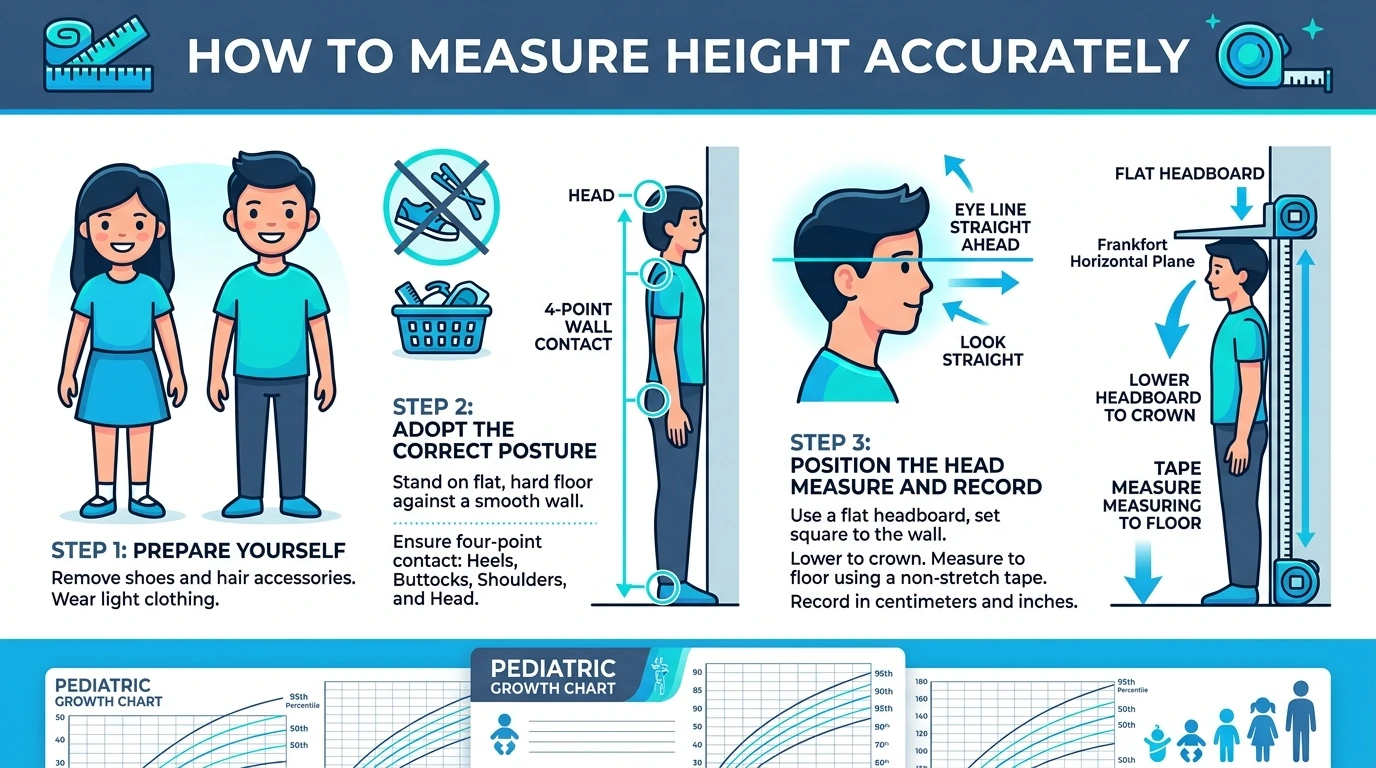
How to Measure Height Accurately
To compare a child's height reliably against national reference charts, follow standard clinical measurement practices:
Remove Footwear: Take off shoes, heavy socks, and bulky hair ornaments.
Select Hard Surface: Stand on a flat, uncarpeted floor against a flat wall.
Position Posture: Stand straight with feet flat together and heels touching the wall.
Four Touch Points: Ensure heels, buttocks, upper back, and head touch the wall surface.
Align Eye Plane: Position line of sight straight ahead (Frankfort horizontal plane parallel to floor).
Lower Flat Headboard: Lower a rigid flat-edged object (like a hard book or stadiometer arm) firmly onto the crown of the head.
Record Accurately: Mark the point with pencil lightly and measure from floor level to mark using a firm tape measure.
Clinical Measurement Protocol: Illustrated step-by-step guide for accurate home standing height measurement against wall standards.
How to Use the Average Height by Age Chart
Follow this step-by-step guide to evaluate height measurements against baseline medians:
Determine Exact Age: Note chronological age in years and months.
Select Sex Category: Choose the appropriate reference table for boys or girls.
Measure Height: Obtain an accurate measurement in cm or inches using proper posture.
Locate Age in Chart: Find the matching age row in the reference table.
Compare Values: Observe how the measured height compares to the 50th percentile median.
Interpret Benchmark Context: Understand that the average is a population baseline, and falling anywhere between the 3rd and 97th percentile represents normal variation.
Average Height by Specific Age
Below is a concise lookup reference for common age-specific stature searches:
Specific Age
Average Boy Height
Average Girl Height
Key Milestone Notes
Age 2
88.8 cm (2' 11.0")
86.4 cm (2' 10.0")
Toddler standing height baseline
Age 3
97.9 cm (3' 2.5")
96.8 cm (3' 2.1")
Preschool transition
Age 4
105.7 cm (3' 5.6")
104.6 cm (3' 5.2")
Doubled birth length benchmark
Age 5
112.7 cm (3' 8.4")
111.7 cm (3' 8.0")
Early primary school entry
Age 6
119.2 cm (3' 11.0")
118.2 cm (3' 10.5")
Steady linear velocity
Age 8
131.1 cm (4' 3.6")
130.4 cm (4' 3.3")
Middle childhood stage
Age 10
142.5 cm (4' 8.1")
143.1 cm (4' 8.3")
Girls pre-pubertal crossover
Age 12
155.3 cm (5' 1.1")
155.2 cm (5' 1.1")
Adolescent transition
Age 14
168.3 cm (5' 6.3")
161.3 cm (5' 3.5")
Boys pubertal peak velocity
Age 16
175.4 cm (5' 9.1")
162.9 cm (5' 4.1")
Girls final adult height zone
Age 18
176.7 cm (5' 9.6")
163.3 cm (5' 4.3")
Adult population reference stature
Average Height by Specific Age: Character milestone guide showing median stature for boys and girls from toddlerhood (Age 2) to adulthood (Age 18).
Average Height Data Source and Methodology
To maintain absolute medical and scientific rigor, all numerical values displayed on this page are derived from recognized national and global public health standards:
WHO Child Growth Standards (Birth to 2 Years): Established by the World Health Organization based on international multi-center growth reference studies monitoring breastfed infants under optimal environmental conditions.
CDC Clinical Growth Charts (Ages 2 to 20 Years): Standardized growth percentiles developed by the National Center for Health Statistics (NCHS) and the Centers for Disease Control and Prevention (CDC) utilizing U.S. National Health and Nutrition Examination Survey (NHANES) multi-decadal data.
Unit Conversions & Rounding: Centimeter standards convert to imperial feet and inches using the exact conversion factor $1 \text{ inch} = 2.54 \text{ cm}$. Imperial values are rounded uniformly to one decimal place.
Important Notes
Educational Disclaimer: Information on this page is intended for informational reference and educational purposes only. Population averages do not constitute clinical medical diagnosis or individual pediatric evaluations.
If you have questions regarding your child's individual growth trajectory, percentile velocity changes, or nutritional requirements, consult a qualified pediatrician or pediatric endocrinologist.
Frequently Asked Questions (FAQ)
Average height by age is the statistical 50th percentile median height for children of a specific age and sex within standardized reference datasets (WHO standards for ages 0–2 and CDC charts for ages 2–20). For example, median height is 76.5 cm (2' 6.1") at age 1, 105.7 cm (3' 5.6") at age 4, and 142.5 cm (4' 8.1") at age 10 for boys.
According to CDC reference standards, median height for boys is 76.5 cm (2' 6.1") at age 1, 88.8 cm (2' 11.0") at age 2, 105.7 cm (3' 5.6") at age 4, 119.2 cm (3' 11.0") at age 6, 131.1 cm (4' 3.6") at age 8, 142.5 cm (4' 8.1") at age 10, 155.3 cm (5' 1.1") at age 12, 168.3 cm (5' 6.3") at age 14, 175.4 cm (5' 9.1") at age 16, and 176.7 cm (5' 9.6") at age 18.
Based on CDC standards, median height for girls is 74.0 cm (2' 5.1") at age 1, 86.4 cm (2' 10.0") at age 2, 104.6 cm (3' 5.2") at age 4, 118.2 cm (3' 10.5") at age 6, 130.4 cm (4' 3.3") at age 8, 143.1 cm (4' 8.3") at age 10, 155.2 cm (5' 1.1") at age 12, 161.3 cm (5' 3.5") at age 14, 162.9 cm (5' 4.1") at age 16, and 163.3 cm (5' 4.3") at age 18.
At 10 years old, the median height for a boy is 142.5 cm (4 feet 8.1 inches), while the median height for a girl is 143.1 cm (4 feet 8.3 inches). Girls frequently equal or slightly exceed boys in height at age 10 due to earlier pubertal growth spurts.
At 12 years of age, the median height is 155.3 cm (5 feet 1.1 inches) for boys and 155.2 cm (5 feet 1.1 inches) for girls.
Teenage median height increases rapidly during pubertal growth spurts. At age 13, median height is 162.2 cm (5' 3.9") for boys and 159.1 cm (5' 2.6") for girls. By age 16, median height reaches 175.4 cm (5' 9.1") for boys and 162.9 cm (5' 4.1") for girls.
Average (median) height is the single 50th percentile midpoint value for a population. A height percentile is a rank from 1st to 99th showing what percentage of age- and sex-matched peers an individual child is taller than.
The 50th percentile is the statistical median line where exactly 50% of reference children are taller and 50% are shorter. It serves as a central reference benchmark, not a required target.
Infants grow ~25 cm (10 in) in their first year. Toddlers gain ~12 cm (4.7 in) in year two and 8 cm in year three. Preschool and school-age children gain ~5 to 7 cm (2–2.8 in) per year. During peak pubertal growth spurts, velocity accelerates to 7–10 cm (2.8–4 in) annually.
Children of the same chronological age differ in height due to parental genetics, biological maturation rates, timing of pubertal growth spurts, nutrition, sleep quality, and overall health.
Height growth slows down as growth plates (epiphyseal plates) fuse. For girls, growth tapers off between ages 14 and 16 (typically 2 to 2.5 years after menarche). For boys, growth slows between ages 16 and 18, with final plate closure around age 18 to 20.
Remove shoes and hair accessories, stand flat on a hard surface with heels, buttocks, shoulders, and head touching a wall, align line of sight straight ahead, lower a flat headboard to the crown, mark lightly, and measure from floor to mark.
No. Average height is a population statistical reference, not a required medical target. Healthy children fall across a wide range of percentiles (typically between the 3rd and 97th percentiles). Consistent growth along an individual curve is the true key to health.