Boys Stature-for-Age Growth Curves
Visual percentile curves showing 3rd, 10th, 25th, 50th, 75th, 90th, and 97th percentiles based on official CDC growth standards.
Boys Height Reference Table (cm & ft/in)
| Age | 3rd % | 25th % | 50th % Median | 75th % | 97th % |
|---|---|---|---|---|---|
| 2 Years | 81.5 cm | 86.2 cm | 88.8 cm (2' 11") | 91.4 cm | 96.1 cm |
| 4 Years | 97.5 cm | 102.8 cm | 105.7 cm (3' 5.6") | 108.6 cm | 113.9 cm |
| 6 Years | 110.0 cm | 115.9 cm | 119.2 cm (3' 11") | 122.5 cm | 128.4 cm |
| 8 Years | 121.0 cm | 127.4 cm | 131.1 cm (4' 3.6") | 134.8 cm | 141.2 cm |
| 10 Years | 131.2 cm | 138.3 cm | 142.5 cm (4' 8.1") | 146.7 cm | 153.8 cm |
| 12 Years | 142.1 cm | 150.2 cm | 155.3 cm (5' 1.1") | 160.4 cm | 168.5 cm |
| 14 Years | 154.5 cm | 163.6 cm | 168.3 cm (5' 6.3") | 173.0 cm | 181.8 cm |
| 16 Years | 162.8 cm | 171.2 cm | 175.4 cm (5' 9.1") | 179.6 cm | 187.8 cm |
| 18 Years | 164.9 cm | 172.8 cm | 176.7 cm (5' 9.6") | 180.6 cm | 188.5 cm |
Understanding the Boys Height Chart by Age
A boys height chart is an essential reference tool used by pediatricians, clinical specialists, and parents (in line with guidance from organizations like the American Academy of Pediatrics (AAP)) to monitor physical growth and developmental progress in male children. The chart above displays standardized stature-for-age data, presenting height measurements across key developmental milestones from early childhood through early adulthood.
To use the chart effectively, locate your child's age along the horizontal axis (or left table column) and follow the row across to compare his height against standardized percentile positions. These values allow you to see how your son's stature compares with a healthy population of boys of the exact same age derived from official CDC Stature-for-Age growth charts.
For instant percentile calculation tailored to your child's exact age in years and months, try our interactive Height Percentile Calculator or dedicated Child Height Percentile Calculator.
Average Height for Boys by Age
Parents frequently ask about the average height for boys at specific ages. In pediatric growth charts, "average" height refers to the 50th percentile (median) value established by clinical reference datasets published by the CDC National Center for Health Statistics (NCHS).
The table below summarizes median statures for boys from age 2 through 18 in both metric (centimeters) and imperial (feet and inches) units:
| Age | Median Height (cm) | Median Height (ft & in) | Typical Height Span (25th - 75th %) |
|---|---|---|---|
| 2 Years | 88.8 cm | 2' 11.0" | 86.2 cm – 91.4 cm (2' 9.9" – 3' 0.0") |
| 3 Years | 97.9 cm | 3' 2.5" | 95.5 cm – 100.3 cm (3' 1.6" – 3' 3.5") |
| 4 Years | 105.7 cm | 3' 5.6" | 102.8 cm – 108.6 cm (3' 4.5" – 3' 6.8") |
| 5 Years | 112.7 cm | 3' 8.4" | 109.6 cm – 115.8 cm (3' 7.2" – 3' 9.6") |
| 6 Years | 119.2 cm | 3' 11.0" | 115.9 cm – 122.5 cm (3' 9.6" – 4' 0.2") |
| 7 Years | 125.3 cm | 4' 1.3" | 121.7 cm – 128.9 cm (3' 11.9" – 4' 2.7") |
| 8 Years | 131.1 cm | 4' 3.6" | 127.4 cm – 134.8 cm (4' 2.1" – 4' 5.1") |
| 9 Years | 136.7 cm | 4' 5.8" | 132.5 cm – 140.9 cm (4' 4.2" – 4' 7.5") |
| 10 Years | 142.5 cm | 4' 8.1" | 138.3 cm – 146.7 cm (4' 6.5" – 4' 9.8") |
| 11 Years | 148.6 cm | 4' 10.5" | 143.6 cm – 153.6 cm (4' 8.5" – 5' 0.5") |
| 12 Years | 155.3 cm | 5' 1.1" | 150.2 cm – 160.4 cm (4' 11.1" – 5' 3.1") |
| 13 Years | 162.2 cm | 5' 3.9" | 156.3 cm – 168.0 cm (5' 1.5" – 5' 6.1") |
| 14 Years | 168.3 cm | 5' 6.3" | 163.6 cm – 173.0 cm (5' 4.4" – 5' 8.1") |
| 15 Years | 172.8 cm | 5' 8.0" | 166.7 cm – 178.9 cm (5' 5.6" – 5' 10.4") |
| 16 Years | 175.4 cm | 5' 9.1" | 171.2 cm – 179.6 cm (5' 7.4" – 5' 10.7") |
| 17 Years | 176.4 cm | 5' 9.5" | 170.7 cm – 182.1 cm (5' 7.2" – 5' 11.7") |
| 18 Years | 176.7 cm | 5' 9.6" | 172.8 cm – 180.6 cm (5' 8.0" – 5' 11.1") |
It is important to remember that the median is simply a statistical reference point. Healthy individual boys naturally grow at different rates and may be shorter or taller than the median while following a perfectly normal developmental trajectory. Compare male growth with female milestones on our Girls Height Chart or see overall population summaries on Average Height by Age.
Boys Height Percentile Chart Explained
A boys height percentile compares an individual boy's height with a normative population group of 100 healthy male peers of the exact same age.
Standard clinical percentile channels include the 3rd, 5th, 10th, 25th, 50th, 75th, 90th, 95th, and 97th percentiles:
- 3rd Percentile: Only 3% of boys are shorter; 97% are taller. This forms the lower boundary of standard clinical growth charts.
- 10th Percentile: 10% of boys are shorter; 90% are taller.
- 25th Percentile: 25% of boys are shorter; 75% are taller. Indicates a slightly shorter than median stature.
- 50th Percentile (Median): Exactly 50% of boys are shorter and 50% are taller.
- 75th Percentile: 75% of boys are shorter; 25% are taller. Represents an above-median stature.
- 90th Percentile: 90% of boys are shorter; 10% are taller.
- 97th Percentile: 97% of boys are shorter; only 3% are taller. Represents the upper standard clinical boundary.
Being in any percentile channel between the 3rd and 97th percentiles is generally considered healthy when a child grows steadily along their established curve.

How to Read a Boys Height Chart
Reading a growth chart accurately involves a simple step-by-step process:
- Find the Boy's Age: Determine his exact age in years and completed months. On visual charts, locate age along the horizontal baseline axis.
- Find His Measured Height: Measure his standing height accurately in centimeters or inches. Locate this value along the vertical axis.
- Compare Measurement with the Chart: Follow the age line upward and the height line across until they intersect.
- Understand the Percentile Channel: Identify which curved percentile line lies closest to the intersection point. If the point falls between lines (e.g., between 50th and 75th), your boy's percentile lies within that interval.
- Track Measurements Over Time: Plot successive measurements over months and years to ensure he is following a consistent growth trajectory.
Boys Height by Age in cm
Centimeters (cm) are the standard unit of measurement used in clinical practice and international pediatric studies. Using metric measurements ensures high precision when calculating percentile rankings and Z-scores.
| Age | 3rd % (cm) | 25th % (cm) | 50th % Median (cm) | 75th % (cm) | 97th % (cm) |
|---|---|---|---|---|---|
| 2 Years | 81.5 cm | 86.2 cm | 88.8 cm | 91.4 cm | 96.1 cm |
| 4 Years | 97.5 cm | 102.8 cm | 105.7 cm | 108.6 cm | 113.9 cm |
| 6 Years | 110.0 cm | 115.9 cm | 119.2 cm | 122.5 cm | 128.4 cm |
| 8 Years | 121.0 cm | 127.4 cm | 131.1 cm | 134.8 cm | 141.2 cm |
| 10 Years | 131.2 cm | 138.3 cm | 142.5 cm | 146.7 cm | 153.8 cm |
| 12 Years | 142.1 cm | 150.2 cm | 155.3 cm | 160.4 cm | 168.5 cm |
| 14 Years | 154.5 cm | 163.6 cm | 168.3 cm | 173.0 cm | 181.8 cm |
| 16 Years | 162.8 cm | 171.2 cm | 175.4 cm | 179.6 cm | 187.8 cm |
| 18 Years | 164.9 cm | 172.8 cm | 176.7 cm | 180.6 cm | 188.5 cm |
If you have measurements in inches and need quick metric conversions, use our handy Height Converter.
Boys Height by Age in Feet and Inches
For users in the United States and regions using imperial measurements, height is typically expressed in feet and inches. Below is the equivalent reference table for boys, mathematically converted from WHO and CDC reference datasets (1 inch = 2.54 cm):
| Age | 3rd % (ft/in) | 25th % (ft/in) | 50th % Median (ft/in) | 75th % (ft/in) | 97th % (ft/in) |
|---|---|---|---|---|---|
| 2 Years | 2' 8.1" | 2' 9.9" | 2' 11.0" | 3' 0.0" | 3' 1.8" |
| 4 Years | 3' 2.4" | 3' 4.5" | 3' 5.6" | 3' 6.8" | 3' 8.8" |
| 6 Years | 3' 7.3" | 3' 9.6" | 3' 11.0" | 4' 0.2" | 4' 2.5" |
| 8 Years | 3' 11.6" | 4' 2.1" | 4' 3.6" | 4' 5.1" | 4' 7.6" |
| 10 Years | 4' 3.6" | 4' 6.5" | 4' 8.1" | 4' 9.8" | 5' 0.5" |
| 12 Years | 4' 7.9" | 4' 11.1" | 5' 1.1" | 5' 3.1" | 5' 6.3" |
| 14 Years | 5' 0.8" | 5' 4.4" | 5' 6.3" | 5' 8.1" | 5' 11.6" |
| 16 Years | 5' 4.1" | 5' 7.4" | 5' 9.1" | 5' 10.7" | 6' 1.9" |
| 18 Years | 5' 4.9" | 5' 8.0" | 5' 9.6" | 5' 11.1" | 6' 2.2" |
Height Range for Boys by Age
Boys of the exact same age can differ substantially in height. Rather than defining a single "normal" height, pediatric growth standards outline a wide physiological height range spanning from the 3rd to the 97th percentile.
For instance, at age 12, a boy at the 3rd percentile measures approximately 142.1 cm (4' 7.9"), while a peer at the 97th percentile measures approximately 168.5 cm (5' 6.3"). Both boys fall within healthy reference limits. Variations in growth timing, bone maturation, and genetics account for these natural differences.

How Boys' Height Changes With Age
Male height development proceeds through four distinct physiological stages, aligned with international growth monitoring standards from the World Health Organization (WHO):
- Infancy and Early Toddlerhood (0–2 Years): Rapid growth velocity. An average male infant gains roughly 25 cm (10 inches) in his first year and 12 cm (4.7 inches) in his second year.
- Middle Childhood (3–10 Years): Steady linear growth. Boys grow at a stable rate of approximately 5 to 7 cm (2 to 2.5 inches) per year.
- Adolescent Growth Spurt (11–16 Years): Acceleration stage. Driven by pubertal hormones, annual growth rates increase significantly.
- Late Adolescence (16–20 Years): Deceleration stage. Growth slows down as bone growth plates complete fusion.

How Much Do Boys Grow Each Year?
Annual growth velocity measures how many centimeters or inches a boy gains per year. Typical average rates include:
- Age 2 to 3 years: ~8 to 9 cm (3.1 to 3.5 inches) per year
- Age 4 to 9 years: ~5 to 6.5 cm (2 to 2.6 inches) per year
- Pubertal Peak (Age 13–15 years): ~8 to 12 cm (3.1 to 4.7 inches) per year

Growth velocity is rarely uniform throughout twelve calendar months; seasonal spurts and quiet periods are completely normal.
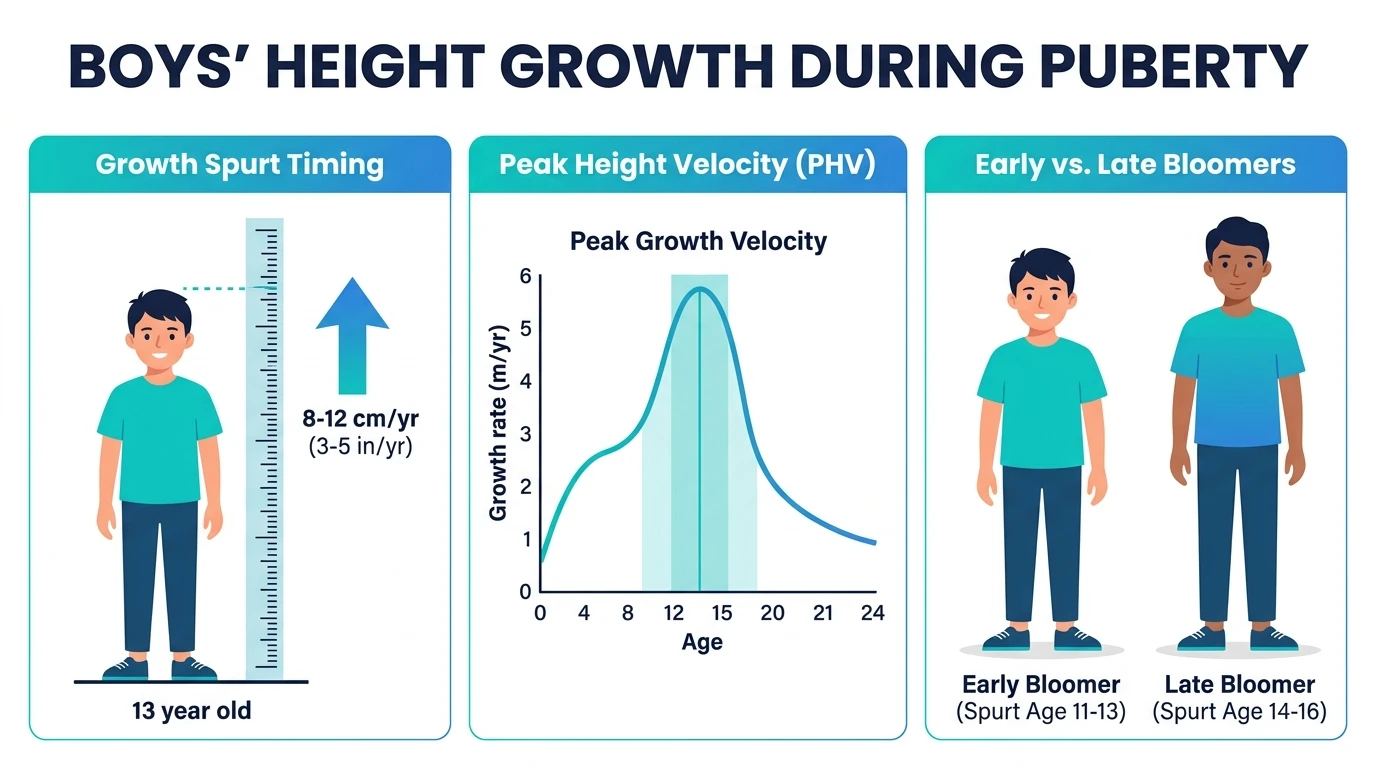
Boys' Height Growth During Puberty
Puberty introduces dramatic changes in male height trajectory. Key features of pubertal growth in boys include:
- Timing of the Male Growth Spurt: Boys typically begin their pubertal growth spurt about two years later than girls, usually between ages 12 and 15.
- Peak Height Velocity (PHV): During peak growth years, boys can gain 8 to 12 cm (3 to 5 inches) in a single 12-month period.
- Early vs. Late Bloomers: Boys who enter puberty early ("early bloomers") may temporarily appear much taller than peers. "Late bloomers" spurt later in their mid-teens and often catch up or surpass earlier growers.
When Do Boys Stop Growing?
Linear height growth ceases when the epiphyseal growth plates at the ends of long bones fuse. In boys:
- Most boys achieve 95% or more of their final adult height by age 16 to 17.
- Complete skeletal maturation and final growth plate fusion generally occur between ages 18 and 20.
- In rare cases of late pubertal maturation, minor growth may continue slightly past age 20.
Factors That Affect Boys' Height
A boy's final stature is shaped by an interplay of genetic and environmental influences:
- Genetics (Parental Height): Heredity accounts for approximately 80% of variation in adult height, as documented in genetics research from the National Institutes of Health (NIH).
- Nutrition: Adequate calorie intake, high-quality protein, calcium, phosphorus, and vitamin D support bone elongation.
- Sleep Quality: Deep Stage 3 NREM sleep stimulates the pituitary gland to release pulsatile Human Growth Hormone (HGH), according to sleep studies indexed on PubMed.
- Physical Activity: Regular weight-bearing movement promotes healthy bone density and mechanical skeletal stimulation.
- Pubertal Maturation Rate: The onset timing and duration of pubertal hormone release directly influence the duration of active bone growth.

How to Measure a Boy's Height Correctly
Accurate measurements prevent misinterpreting growth chart percentiles. Following standardized protocols adapted from CDC Anthropometric Measurement Guidelines, follow these practical steps:
- Remove Barriers: Have the boy remove shoes, socks, heavy clothing, and hair items.
- Select Surface: Stand him on a hard, uncarpeted floor against a flat, vertical wall.
- Position Body (4-Point Contact): Ensure the back of the head, shoulder blades, buttocks, and heels touch the wall surface.
- Align Feet: Keep feet flat with heels touching and toes pointing slightly outward.
- Head Alignment (Frankfort Plane): Position his head so his line of vision is parallel to the floor (eyes looking straight ahead).
- Use a Rigid Headboard: Lower a flat, right-angled block or firm headboard down to compress hair lightly against the crown.
- Record Measurement: Mark and read the height to the nearest 0.1 cm or 1/8 inch. Repeat to confirm accuracy.

Why One Height Measurement Is Not Enough: Tracking Growth Over Time
A single height measurement provides only a snapshot in time. A boy who falls on the 25th percentile at age 8 is growing normally if he has consistently followed the 25th percentile curve since toddlerhood.
Tracking serial height measurements allows parents and pediatricians to evaluate growth velocity and identify sudden upward or downward percentile shifts early.
Maintain a simple annual log recorded at home or during well-child visits:
- Date of measurement
- Exact age in years and months
- Measured height (cm or ft/in)
- Calculated percentile channel (using our Height Percentile Calculator)
Average Height vs Height Percentile: What Does the 50th Percentile Mean?
It is common to confuse average height with a height percentile:
- Average / Median Height (50th Percentile): The exact midpoint of the population dataset. Half of healthy boys measure above this point and half measure below it.
- Height Percentile: A relative score indicating what percentage of peers your boy exceeds in stature.
- Individual Height Measurement: The raw stature value recorded in centimeters or feet and inches.
Example: A 10-year-old boy who measures 148 cm is in approximately the 75th percentile. This means he is taller than 75% of 10-year-old boys and shorter than 25%. His height is above average, but completely normal and healthy.
Expected Adult Height From Childhood Height
Parents often wonder how tall their boy will grow to be as an adult. While individual growth paths vary, pediatricians estimate target adult height using the Mid-Parental Height Method:
Target Adult Height for Boys (cm) = [ Father's Height (cm) + Mother's Height (cm) + 13 cm ] ÷ 2
In imperial units: [ Father's Height (in) + Mother's Height (in) + 5 in ] ÷ 2. Most healthy boys achieve a final adult height within ±5 cm (±2 inches) of this calculated target.
To estimate your son's predicted adult stature based on parent height and growth trajectory, use our specialized Child Height Prediction Calculator.
Boys Height Chart Data Source and Methodology
The reference curves and values presented on this page are derived directly from authoritative public health growth benchmarks:
- WHO Child Growth Standards (0 to 24 Months): Derived from the World Health Organization Multicentre Growth Reference Study, establishing ideal growth trajectories for infants raised in supportive environments.
- CDC 2000 Growth Charts (2 to 20 Years): Based on clinical stature-for-age datasets published by the CDC National Center for Health Statistics (NCHS).
-
LMS Percentile Calculation Methodology: Percentile curves are constructed using Cole's LMS method (Lambda-Mu-Sigma), published in the European Journal of Clinical Nutrition (PubMed), where L represents skewness transformation, M represents the median, and S represents the coefficient of variation:
Z = [ (X / M)^L - 1 ] / (L * S) - Unit Conversions: Inches and feet calculations use the exact conversion standard maintained by the National Institute of Standards and Technology (NIST) (1 inch = 2.54 cm).
Important Notes About Boys Height Charts
Growth charts are clinical reference population tools designed to monitor growth trends over time. Please keep the following clinical context in mind:
- Population Tool: A growth chart reflects statistical distributions, not an individual health evaluation.
- Percentile Shifts Can Occur: Shifts across percentile channels occur naturally during pubertal timing variations ("early" or "late" bloomers).
- Medical Consultation: If a boy experiences a persistent downward trajectory crossing two or more major percentile lines (e.g., from 50th down to 10th percentile), consult a pediatrician or specialist certified by the American Academy of Pediatrics (AAP) for professional evaluation.
Frequently Asked Questions About Boys Height
Average height varies across developmental stages. At age 2, the median boy is 88.8 cm (2' 11"). By age 6, median height is 119.2 cm (3' 11"). At age 10, it is 142.5 cm (4' 8.1"). At age 14, median height reaches 168.3 cm (5' 6.3"), and by age 18, final median adult height is approximately 176.7 cm (5' 9.6").
The median (50th percentile) height of a 10-year-old boy is approximately 142.5 cm (4 feet 8.1 inches). Healthy 10-year-old boys typically range between 131.2 cm (3rd percentile) and 153.8 cm (97th percentile).
There is no single required height for a 12-year-old boy. The median height is 155.3 cm (5 feet 1.1 inches), but healthy 12-year-olds span from 142.1 cm to 168.5 cm depending on whether their pubertal growth spurt has begun.
The 50th percentile is the exact median height line where 50% of boys in the reference population are taller and 50% are shorter. It is a central reference benchmark, not a target height.
The 90th percentile means a boy is taller than 90% of male peers his exact age, while only 10% are taller.
Yes. A boy's height percentile can shift during growth spurts, particularly during pubertal maturation when growth rates accelerate or decelerate relative to peers.
Measuring standing height once or twice a year is sufficient for healthy children aged 2 to 18 to establish a reliable growth trajectory.
Most boys stop growing linearly between ages 16 and 18 as growth plates fuse, though final skeletal consolidation can continue through age 20.
Height differences stem from genetic inheritance, parents' heights, nutrition, sleep, biological maturation rates, and individual timing of pubertal growth spurts.
Remove shoes, stand him barefoot against a flat wall with head, shoulders, buttocks, and heels touching, align head in the Frankfort horizontal plane, and lower a rigid headboard to the crown of his head.